
Cannabis and marijuana laws in the United States have changed dramatically over the past two decades. Once treated primarily as a criminal issue, cannabis regulation has evolved into a highly complex legal industry involving medical treatment, recreational use, business licensing, taxation, agriculture, healthcare, employment, banking, and criminal justice reform.
Despite widespread legalization efforts at the state level, marijuana remains illegal under federal law, creating a unique and often confusing legal environment for consumers, businesses, healthcare providers, investors, and attorneys.
Understanding USA cannabis and marijuana law is essential for anyone involved in the cannabis industry or using cannabis products legally under state law. This includes patients, dispensary operators, cultivators, investors, employers, and individuals seeking criminal defense or regulatory guidance.
This comprehensive guide explains how cannabis and marijuana laws work in the United States, including legalization frameworks, medical marijuana programs, recreational cannabis rules, licensing requirements, penalties, business compliance, legal costs, and how to choose the right cannabis attorney.
What Is USA Cannabis and Marijuana Law?
USA cannabis and marijuana law refers to federal and state laws regulating:
- Marijuana possession
- Cannabis cultivation
- Medical marijuana programs
- Recreational cannabis sales
- Hemp production
- CBD products
- Cannabis business licensing
- Cannabis taxation
- Drug enforcement policies
Cannabis law combines:
- Criminal law
- Administrative law
- Business regulation
- Healthcare law
- Agricultural law
- Tax law
- Employment law
- Consumer protection law
Because federal and state laws often conflict, cannabis law is one of the most legally complex industries in America.
Difference Between Cannabis, Marijuana, Hemp, and CBD
Understanding terminology is important in cannabis regulation.
Cannabis
Cannabis is the broader plant category containing various cannabinoids.
Marijuana
Marijuana generally refers to cannabis products containing higher THC concentrations that may cause psychoactive effects.
Hemp
Federal law defines hemp as cannabis containing no more than 0.3% THC by dry weight.
CBD (Cannabidiol)
CBD is a non-intoxicating cannabinoid used in wellness and medical products.
Different legal rules apply to each category.
Federal Marijuana Law in the United States
Under federal law, marijuana remains classified as a Schedule I controlled substance under the Controlled Substances Act (CSA).
This classification means the federal government considers marijuana to have:
- High abuse potential
- No accepted medical use under federal standards
Federal marijuana prohibition technically criminalizes:
- Possession
- Distribution
- Cultivation
- Trafficking
However, federal enforcement priorities have evolved significantly in states with legalization programs.
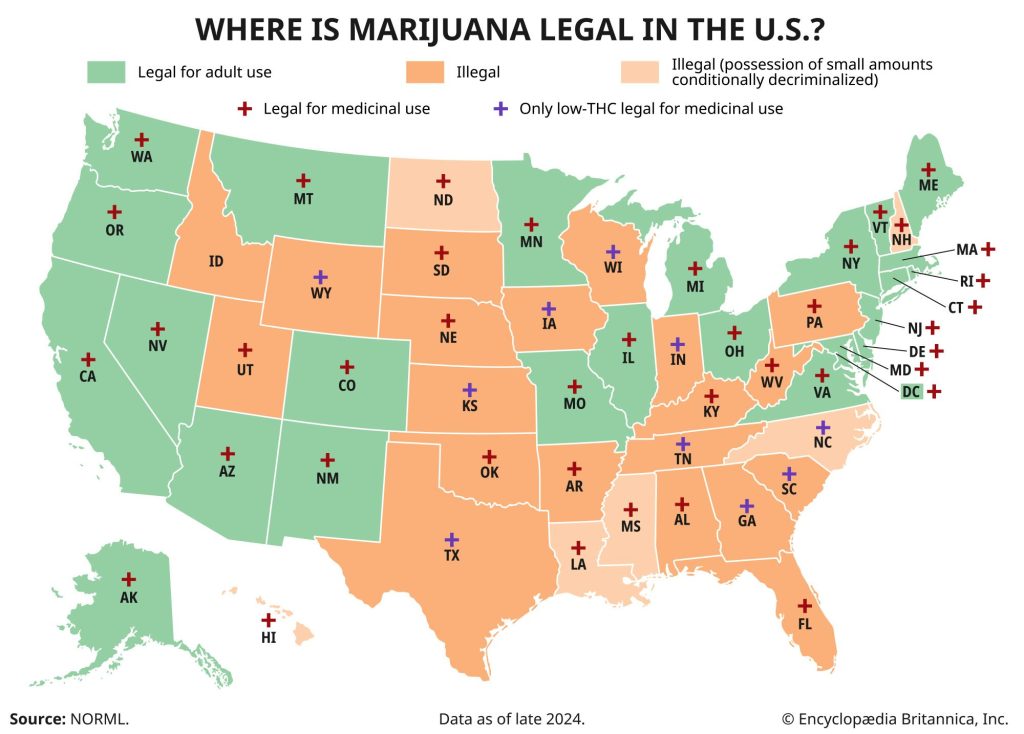
State Marijuana Legalization
Many states have legalized cannabis in some form.
States generally fall into three categories:
Fully Legal Recreational States
These states permit adult recreational cannabis use and regulated commercial sales.
Medical Marijuana States
These states allow cannabis use for approved medical conditions with physician authorization.
Prohibition States
Some states still prohibit most marijuana use and possession.
Because laws vary significantly, individuals and businesses must understand local state regulations carefully.
Medical Marijuana Laws
Medical marijuana programs allow qualifying patients to use cannabis for approved medical conditions.
Common qualifying conditions may include:
- Chronic pain
- Cancer
- PTSD
- Epilepsy
- Multiple sclerosis
- Severe nausea
- HIV/AIDS
Patients usually must:
- Obtain physician certification
- Register with the state
- Receive medical marijuana cards
Rules differ widely between states.
Recreational Cannabis Laws
Recreational legalization permits adult use without medical authorization.
Common recreational rules involve:
- Minimum age requirements
- Possession limits
- Home cultivation limits
- Public consumption restrictions
- Licensed retail sales
Violating state cannabis regulations may still trigger criminal penalties even in legalized states.
Cannabis Possession Laws
Possession laws vary dramatically nationwide.
Legal issues may depend on:
- Quantity possessed
- User age
- Product type
- Location
- State law
Possession beyond legal limits may result in:
- Fines
- Misdemeanor charges
- Felony prosecution in serious cases
Federal property remains subject to federal marijuana laws.
Cannabis Cultivation Laws
Many legalized states allow limited home cultivation.
Regulations may control:
- Plant quantity
- Security requirements
- Residential restrictions
- Licensing requirements for commercial grows
Commercial cultivation businesses face extensive regulation and inspections.
Cannabis Dispensary and Retail Licensing
Cannabis dispensaries require state licensing approval.
Licensing rules may involve:
- Background checks
- Financial disclosures
- Security plans
- Zoning approval
- Product testing compliance
Licenses are often highly competitive and expensive.
Cannabis Business Regulations
Cannabis businesses operate under strict regulatory systems.
Businesses may require compliance involving:
- Product labeling
- Seed-to-sale tracking
- Packaging requirements
- Inventory reporting
- Advertising restrictions
- Health and safety testing
Regulatory violations may lead to:
- License suspension
- Fines
- Business closure
Cannabis Banking and Financial Challenges
Federal illegality creates major banking difficulties for cannabis businesses.
Challenges may include:
- Limited banking access
- Restricted lending
- High compliance costs
- Cash-heavy operations
Many financial institutions remain cautious about servicing cannabis companies.
Cannabis Taxation Laws
Cannabis businesses face unique tax obligations.
State taxes may include:
- Excise taxes
- Retail taxes
- Cultivation taxes
Federal tax law also creates challenges.
Internal Revenue Code Section 280E prevents many cannabis businesses from deducting ordinary business expenses because marijuana remains federally illegal.
This often results in extremely high effective tax rates.
Hemp and CBD Law in America
The 2018 Farm Bill legalized hemp production under federal law.
Legal hemp products must remain below federal THC thresholds.
However, CBD regulation remains complex because:
- FDA oversight continues evolving
- Product labeling rules vary
- Some states impose additional restrictions
Businesses selling CBD products should monitor regulatory developments carefully.
Cannabis Employment Law
Cannabis legalization creates workplace legal disputes.
Issues may involve:
- Drug testing
- Employee accommodations
- Workplace impairment
- Medical marijuana protections
Some states protect medical marijuana users from certain employment discrimination actions.
Federal contractors and safety-sensitive industries often follow stricter rules.
Driving Under the Influence of Cannabis
Driving while impaired by marijuana remains illegal nationwide.
Law enforcement may use:
- Field sobriety tests
- Blood testing
- Drug recognition experts
Penalties may include:
- DUI charges
- License suspension
- Fines
- Jail time
Cannabis legalization does not permit impaired driving.
Cannabis Criminal Defense Law
Despite legalization trends, cannabis-related criminal charges still occur frequently.
Common charges include:
- Illegal distribution
- Unlicensed cultivation
- Interstate trafficking
- Possession beyond legal limits
- Federal marijuana offenses
Defense attorneys may challenge:
Constitutional violations
Search procedures
Evidence handling
Probable cause
Cannabis Expungement and Criminal Record Relief
Many states now allow expungement or resentencing for prior marijuana convictions.
Eligible individuals may seek relief involving:
- Record sealing
- Sentence reductions
- Conviction dismissal
Cannabis reform laws increasingly include criminal justice provisions.
Interstate Cannabis Transportation Issues
Transporting marijuana across state lines remains federally illegal even between legalized states.
Interstate transportation may trigger:
- Federal criminal liability
- Trafficking charges
- Asset forfeiture risks
Businesses must understand interstate commerce restrictions carefully.
Cannabis Advertising and Marketing Regulations
Cannabis advertising faces strict limitations.
Rules may regulate:
- Youth-targeted marketing
- Health claims
- Packaging
- Online advertising
- Billboard placement
Violations can lead to regulatory enforcement.
Product Testing and Consumer Safety Laws
Most legal cannabis markets require laboratory testing for:
- Potency
- Contaminants
- Pesticides
- Mold
- Heavy metals
Testing laws aim to improve consumer safety and product quality.
Real Estate and Cannabis Law
Cannabis businesses face unique property issues involving:
- Zoning restrictions
- Landlord approval
- Federal mortgage concerns
- Municipal licensing rules
Local governments often control where cannabis operations may exist.
Cannabis Investment and Securities Law
Cannabis investors face substantial legal and financial risks.
Issues may include:
- Regulatory uncertainty
- Securities compliance
- Fraud risks
- Banking limitations
Investors should conduct extensive due diligence before funding cannabis ventures.
Federal Enforcement Priorities
Federal enforcement historically focused on:
- Organized crime
- Interstate trafficking
- Sales to minors
- Illegal diversion
Enforcement priorities may shift depending on federal administration policies.
International Cannabis Legal Issues
Cannabis legality varies worldwide.
International travel with marijuana products may create serious legal consequences even when cannabis is legal domestically.
Travelers should avoid transporting cannabis internationally unless specifically authorized by law.
Benefits of Hiring a Cannabis Lawyer
Cannabis law is highly specialized and rapidly changing.
Regulatory Compliance
Attorneys help businesses maintain licensing and operational compliance.
Criminal Defense Representation
Lawyers defend against marijuana-related criminal charges.
Business Formation Guidance
Cannabis attorneys structure compliant companies and investment arrangements.
Contract Drafting
Legal counsel prepares licensing, partnership, and distribution agreements.
Risk Management
Attorneys identify federal, state, and local legal risks proactively.
Cost of Cannabis Legal Services
Legal costs vary depending on complexity.
Licensing Applications
Cannabis licensing projects may cost:
- $5,000 to $100,000+
Criminal Defense Cases
Cannabis-related defense fees may range from:
- $2,000 to $50,000+
Ongoing Business Compliance
Monthly legal compliance costs may involve:
- Retainer agreements
- Regulatory consulting
- Litigation support
Highly regulated markets often require continuous legal oversight.
How to Choose the Best Cannabis Attorney
Selecting the right lawyer is essential.
Look for Cannabis Industry Experience
Choose attorneys with direct cannabis regulatory knowledge.
Review Licensing Experience
Successful licensing history is extremely valuable.
Evaluate Business Law Knowledge
Cannabis law intersects with tax, real estate, employment, and corporate law.
Understand Regulatory Familiarity
Strong attorneys understand local agencies and compliance systems.
Discuss Fees Clearly
Cannabis legal work can become expensive due to regulatory complexity.
Questions to Ask a Cannabis Lawyer
Before hiring counsel, ask:
- How many cannabis clients do you represent?
- Have you handled licensing applications?
- What compliance risks should I prioritize?
- Can you assist with banking and tax issues?
- What are your legal fees?
- Do you handle regulatory investigations?
Future Trends in USA Cannabis Law
Cannabis law continues evolving rapidly.
Major future issues may include:
- Federal legalization
- Banking reform
- Interstate commerce legalization
- Expanded expungement programs
- FDA cannabis regulation
- International cannabis trade
The cannabis industry remains one of the fastest-changing legal sectors in America.
Frequently Asked Questions (FAQ)
Is marijuana legal in the United States?
Marijuana legality depends on state law. However, marijuana remains federally illegal.
What is the difference between hemp and marijuana?
Hemp contains no more than 0.3% THC under federal law, while marijuana generally exceeds that limit.
Can cannabis businesses use normal banks?
Some banks work with cannabis companies, but federal restrictions create major banking challenges.
Can I travel with marijuana between states?
Transporting marijuana across state lines may violate federal law even between legal states.
Is medical marijuana protected under federal law?
Federal law still classifies marijuana as illegal, although many states allow medical use.
Can prior marijuana convictions be expunged?
Some states allow expungement or resentencing for eligible cannabis offenses.
Can employers fire workers for marijuana use?
Possibly. Employment protections vary by state and industry.
Is CBD legal nationwide?
Federally compliant hemp-derived CBD is generally legal, but regulations remain complex.
Do cannabis businesses pay higher taxes?
Yes. Federal tax rules under Section 280E often create unusually high tax burdens.
Should cannabis businesses hire specialized lawyers?
Yes. Cannabis law is highly regulated and requires specialized legal knowledge.
Conclusion
USA cannabis-marijuana law is one of the most rapidly evolving areas of the American legal system. While many states have legalized medical or recreational cannabis, federal prohibition continues creating significant legal complexity for businesses, consumers, healthcare providers, investors, and regulators.
Cannabis law now affects criminal justice, healthcare, taxation, employment, real estate, banking, agriculture, and corporate compliance. Because regulations differ dramatically across jurisdictions and continue changing frequently, individuals and companies involved in the cannabis industry should prioritize proactive legal guidance and compliance planning.
As legalization efforts expand and regulatory systems mature, cannabis law will continue playing a major role in shaping the future of healthcare, commerce, criminal justice reform, and digital business regulation throughout the United States.


